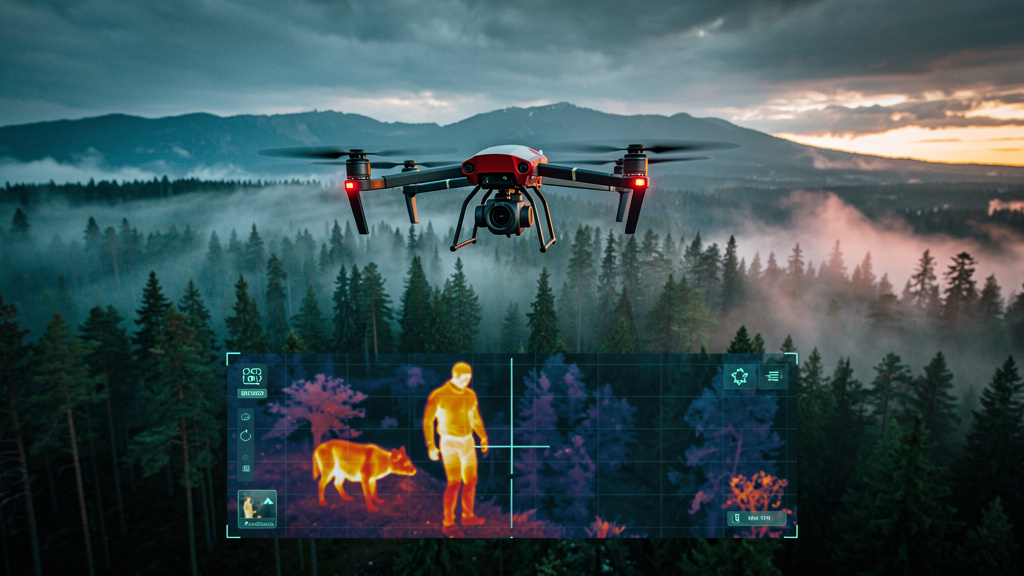
When someone goes missing in wilderness terrain — a forest, a canyon, a mountain ridge — every minute counts. Daylight runs out. Search teams cover ground slower than the missing person can move. And the human eye can miss a body lying in heavy brush from ten feet away.
Thermal imaging changes that math.
How thermal imaging works
A thermal camera doesn't see light — it sees heat. Every object emits infrared radiation, and a thermal sensor translates the temperature differences into a visible image. A 98-degree human body against a 60-degree forest floor lights up like a beacon, even through pitch dark, fog, or thin smoke.
For search teams, that means we can scan terrain at night, through low light, and through visual cover that would hide a person from the naked eye.
Where thermal imaging shines
- Night operations. A missing person who has been outdoors for hours is often hypothermic, weakened, or unable to call out. Thermal
- Heavy brush and dense forest. Thick foliage hides a person from sight, but a body's heat signature often pierces through gaps in vegetation that the eye can't process.
- Drone-based grid searches. Mounted on a UAV, a thermal camera lets a single operator scan acres of terrain in the time a ground team might cover one.
- Recent activity. Thermal can pick up disturbances the eye misses — a heat signature lingering in a bedroll, a vehicle's warm engine, or recent footprints in cool ground.
Where it falls short
Thermal imaging isn't magic. Conditions matter:
- Heavy rain or wet foliage scatters and absorbs infrared, dulling the signal.
- Hot daytime ground can mask a body whose temperature has equalized with surroundings — which is why thermal searches are typically run at night or in cool early-morning hours.
- Heavy canopy and overhead cover still block the view from above.
- The technology can't confirm identity. A heat signature says "something warm is here." Ground confirmation is always required.
The most effective wilderness searches pair thermal imaging with traditional methods: trained SAR teams, K-9 units, structured drone grid patterns, and on-ground forensics.
How SEARCH integrates thermal
Our SAR operations use thermal-equipped drones for nighttime and dense-terrain searches, deployed alongside ground teams and K-9 units. Thermal isn't a substitute for fieldwork — it's a force multiplier that helps us cover more ground, faster, in conditions where conventional searching falls short.
If you're facing a missing-person situation in wilderness terrain, time is the most important variable. Call us at 877-619-9890. Our team is available 24/7.